
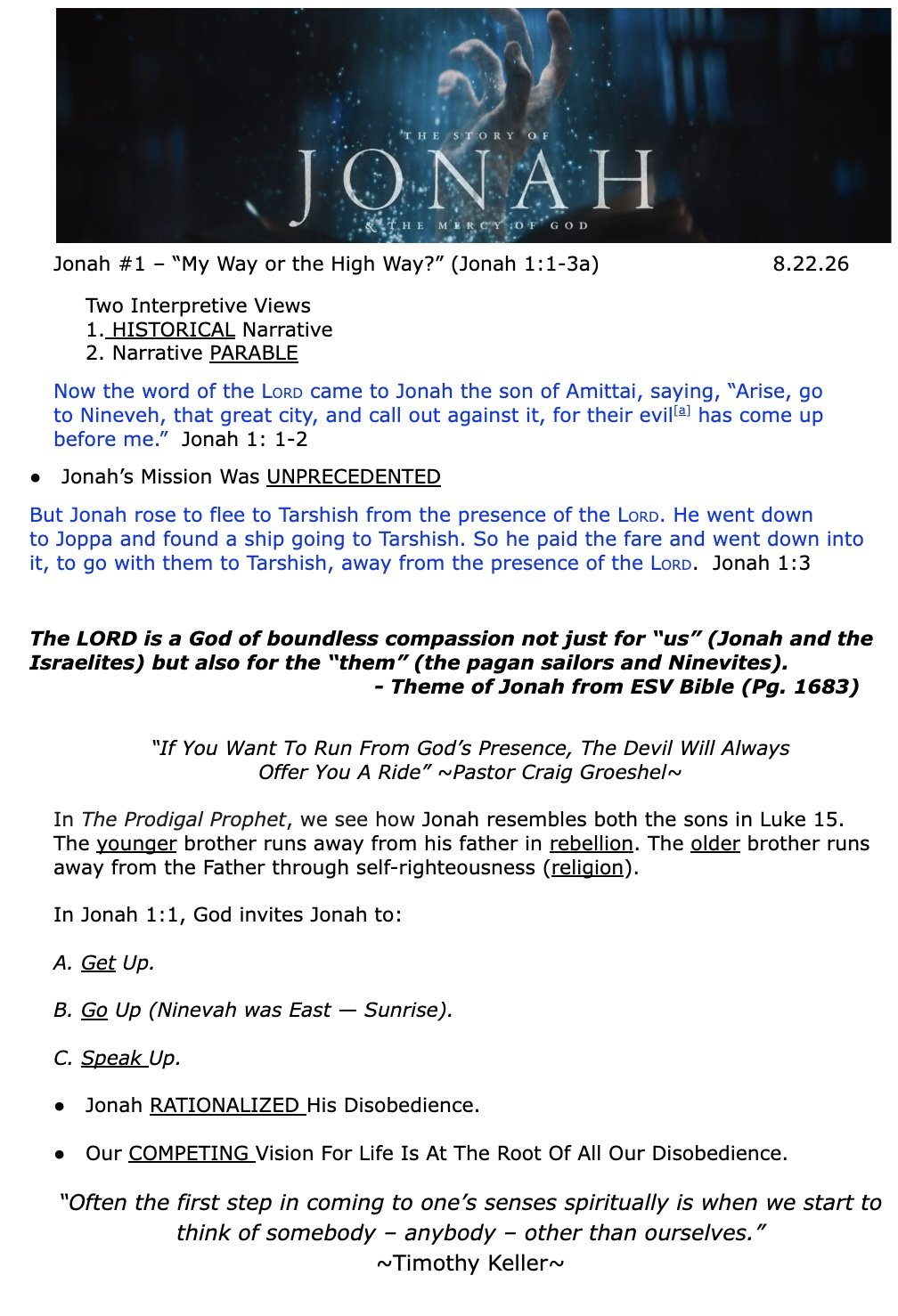
Yahweh, Not My Way: Following God’s Way Instead of Our Own
The book of Jonah is much more than a story about a man and a great fish.
It is a story about God’s mercy, our hearts, and the struggle we all face when God’s ways don’t line up with our own.
As we begin our new series through Jonah at Hope Chapel North Shore, we are invited to look at this familiar story in a new way. Jonah is not simply a prophet who ran from God. He is a mirror that helps us see our own hearts.
“Arise, Go…”
Jonah 1:1–3 begins with a clear command from God:
“Arise, go to Nineveh, that great city, and call out against it, for their evil has come up before me.”
God tells Jonah to go east to Nineveh.
Instead, Jonah goes west.
He finds a ship heading toward Tarshish, pays the fare, and attempts to get as far away from God’s assignment as possible.
Nineveh was not an easy place to go. The Assyrians were known for their brutality and violence. They were enemies of Israel, and Jonah had every reason to dislike them.
But Jonah’s biggest problem wasn't simply that Nineveh was dangerous.
Jonah didn’t want God to show mercy to them.
Jonah knew what God was like. He knew that God was gracious, compassionate, slow to anger, and abundant in mercy. Jonah was afraid that if he preached to Nineveh, they might actually repent—and God might forgive them.
Jonah wanted God’s mercy for himself and his people.
He just didn't want God’s mercy for his enemies.
And if we're honest, we can be a lot like Jonah.
The Book of Jonah Is a Mirror
Jonah exposes some of the tendencies that can exist in our own hearts:
Pride.
Hard-heartedness.
Judgmentalism.
Tribalism.
Self-righteousness.
Small-mindedness.
Resistance to change.
The book asks us to honestly consider:
Where am I choosing my way instead of God’s way?
Sometimes running from God doesn't look like rejecting God or becoming an atheist.
Sometimes it sounds like:
“God, I believe in You, but I want to run my own life.”
We can believe in God while still trying to remain on the throne of our own lives.
We can say, “My way or the highway,” even while claiming to follow Jesus.
But God's invitation is different:
“Yahweh, not my way.”
God’s Ways Are Higher
Isaiah 55:6–9 gives us the perfect backdrop for Jonah:
“Seek the LORD while he may be found;
call upon him while he is near;
let the wicked forsake his way,
and the unrighteous man his thoughts;
let him return to the LORD…”
Then God reminds us:
“For my thoughts are not your thoughts,
neither are your ways my ways…”
God's ways are higher than ours.
That means following Jesus will sometimes require us to surrender our preferences, our comfort, our plans, and even our understanding of what seems fair.
God may ask us to forgive someone we don't want to forgive.
He may ask us to love someone who has hurt us.
He may call us to serve when we would rather be comfortable.
He may ask us to go somewhere we don't want to go.
He may ask us to show mercy to someone we don't think deserves it.
And when He does, we have a choice:
My way—or His way?
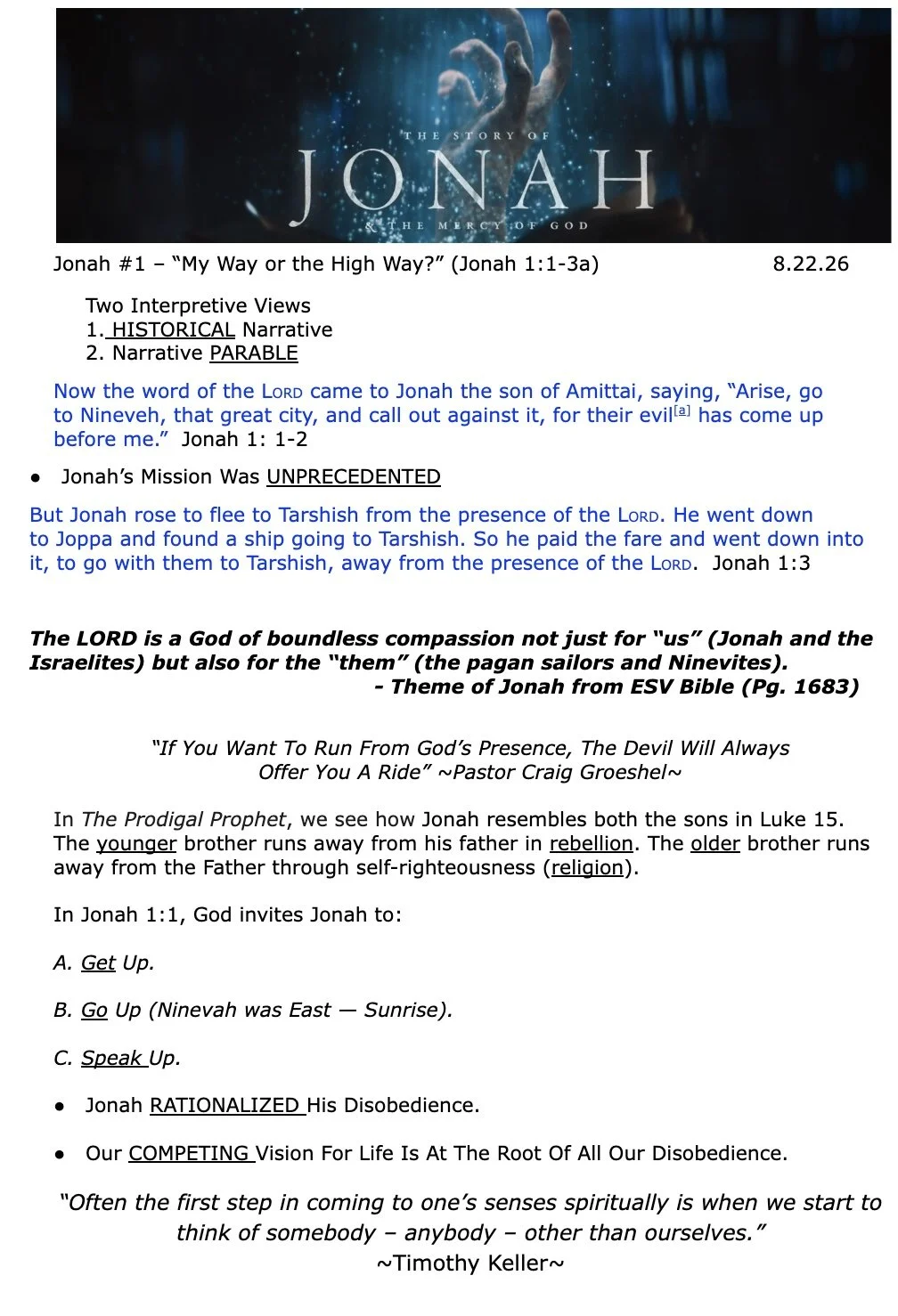
Who Is Really at the Center?
Jonah's story ultimately forces us to ask a deeper question:
Who is sitting on the throne of my life?
We can make ministry, money, family, success, comfort, relationships, reputation, or the approval of others into functional gods.
But Jesus invites us into something better.
Instead of grabbing the steering paddle and deciding where our lives should go, we surrender the direction to Him.
Jesus said:
“I am the way, and the truth, and the life.”
Jesus isn't simply showing us a better way.
Jesus is the Way.
Four Kinds of Obedience
One practical question from this message is worth carrying with us this week:
What does my obedience to God look like right now?
Sometimes our obedience is delayed.
“Eventually, I'll do what God asked.”
But delayed obedience is still disobedience.
Sometimes our obedience is complaining obedience.
“I'll do it, but I want everyone to know how difficult this is.”
Sometimes our obedience is joyful obedience.
“God, I trust You. I don't understand everything, but I believe Your way is better.”
And sometimes God calls us into radical obedience.
“Everything I have belongs to You. My plans, my future, my relationships, my resources, my dreams. I'm Yours.”
Where are you today?
God’s Mercy Is Bigger Than Us
The central message of Jonah isn't ultimately about Jonah.
It's about God.
The Lord is a God of boundless compassion—not only for “us,” but also for “them.”
His mercy reaches beyond our preferences, our tribes, our comfort zones, and the people we think deserve it.
That's why Jonah can be such an uncomfortable book.
It reminds us that God's grace is bigger than our categories.
The people we would write off may be the very people God is pursuing.
The people we don't want to forgive may be people God wants us to love.
The people we don't think deserve mercy are still people made in God's image.
And if God can work through Jonah, He can work through us.
Jesus Is the Ultimate Example
Jonah ran from God's will.
Jesus surrendered Himself to God's will.
In the garden, Jesus prayed:
“Not my will, but yours, be done.”
That is the heart of Christian discipleship.
Not:
“My way.”
But:
“Your way, Lord.”
Not:
“What makes me most comfortable?”
But:
“What brings You the most glory?”
Not:
“Who deserves mercy?”
But:
“How can I love the people You have placed around me?”
Jesus is the ultimate example of trusting the Father completely.
So, What Is God Asking You to Do?
As we begin our journey through Jonah, take some time to ask yourself:
Where am I running from God?
Where have I chosen my preferences over God's commands?
Is there someone I am struggling to forgive or show mercy toward?
Who or what is really at the center of my life?
Is my obedience delayed, complaining, joyful, or radical?
What would it look like for me to say, “Yahweh, not my way”?
The good news is that God's confrontation is not condemnation.
It is an invitation.
An invitation to come home.
An invitation to surrender.
An invitation to trust that His ways really are higher than ours.
And an invitation to discover that even when we don't understand what God is doing, He is still working.
As we sang together, He is our Way Maker, Miracle Worker, Promise Keeper, and Light in the Darkness.
That is who He is.
So as we begin Jonah, may our prayer be simple:
“Yahweh, not my way.”
May we follow His way, trust His heart, receive His mercy, and extend that same mercy to the people around us.
Because God's vision for our lives is always greater than our own.
To God be the glory.